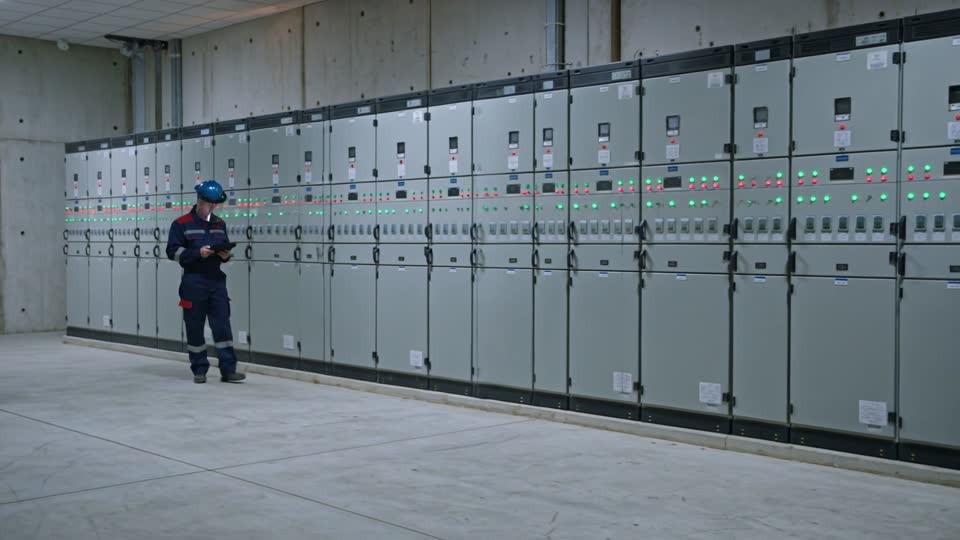
Guide · E-406
CT metering explained for commercial services
Above 200 A, ENMAX does not run a commercial service straight through the meter. The meter reads the load through current transformers, and the customer’s switchgear has to be built around that arrangement.
This guide is for owners, developers, general contractors and property managers who see “CT metering” on a drawing, a quotation or an ENMAX letter and want to know what it commits them to. It explains the arrangement, the paperwork and the billing that follows. It is background, not an instruction for working on metering equipment, and ENMAX’s current metering standard governs every installation.
CCT 01What a current transformer does
A small service uses a self-contained meter: the full load current passes through the meter itself. That stops being practical as the service gets larger. Instead, a current transformer is placed around each service conductor. It produces a small secondary current in fixed proportion to the current in the conductor, and the meter measures that small current.
The proportion is the CT ratio, and the meter or the billing system applies it as a multiplier to register what the building actually used. As a purely hypothetical example, a CT ratio of 800:5 means every 5 A the meter sees stands for 800 A in the conductor, so the multiplier is 160. If the ratio recorded for billing does not match the CTs installed, every bill is wrong by the same factor. That is why the ratio belongs in the building’s records, not only on the utility’s file.
At primary voltage, voltage transformers are added so the meter also sees a scaled-down voltage. For most Calgary commercial buildings served at secondary voltage, it is the current side that makes a service “CT metered”.
CT metering is about the size of the service, not the number of phases. A three-phase service can be self-contained or CT metered. The trigger ENMAX uses is the service rating, explained next. The difference between 120/208 V and 347/600 V supplies is covered in the voltage guide.
CCT 02The ENMAX trigger: services rated over 200 A
ENMAX requires a CT request form and a CT meter installation checklist for services rated over 200 A. 1 The form tells ENMAX what is being built. The checklist is how the installation is confirmed against the ENMAX metering standard before the site can be energized.
Three practical points follow from that rule:
- It is decided at design, not at energization. Whether the service is over 200 A is fixed when the service size is chosen, so the CT request belongs with the service design and the ENMAX application, not with the final inspection.
- A manufacturer’s standard drawing is not utility acceptance. Switchgear vendors offer CT compartments, but the arrangement ENMAX accepts is set by its standard and its review, not by the catalogue.
- Upgrades cross the line too. An existing 200 A self-contained service upgraded to anything larger becomes a CT-metered service. The metering change is part of the upgrade scope, and the commercial service upgrades page covers the rest of that work.
The rest of the utility sequence, from the intake request to ENMAX’s investment and the customer contribution, is in the ENMAX commercial service connection guide.
CCT 03What the customer supplies, and what ENMAX does
The dividing line on a CT-metered service is clear on some items and needs confirming on others. The customer must provide, own and install a CSA-approved meter socket or meter enclosure. 2 ENMAX restricts electrical contractors from handling meters and from cutting secondary supply connections. 3
| Item | Responsibility | What to check |
|---|---|---|
| Meter socket or meter enclosure | Customer supplies, owns and installs | CSA-approved, and to the ENMAX metering standard |
| CT compartment in the switchgear, or a separate CT cabinet | Customer’s switchgear supplier and electrical contractor | Dimensions, sealing provisions and access match the accepted arrangement |
| The current transformers and the metering wiring | Confirm on the CT request | Who supplies, who installs and who connects, in writing |
| Revenue meter | ENMAX | Contractors are restricted from handling meters |
| Energization | ENMAX, after inspection approval | Requested through the retailer |
The row that causes disputes is the third one. Do not let the switchgear quotation, the electrical quotation and the ENMAX estimate each assume someone else supplies the CTs or runs the metering conductors. Put the answer in the responsibility matrix before any of them is accepted.
CCT 04Why CT metering is a procurement problem
On a larger service, the CT compartment is part of the switchgear, and switchgear is built to shop drawings. If the metering section is wrong, it is wrong in steel. Revising a drawing before release costs a review cycle. Revising gear after it is built costs far more, and it can hold up energization of the whole building.
The sensible order is:
- Settle the service size from a load calculation or recorded demand. The service capacity calculator shows the arithmetic, and the three-phase kVA and amps calculator converts between kVA and amps.
- Submit the ENMAX application and CT request with the single-line diagram.
- Get the metering arrangement accepted, then release the switchgear shop drawings for manufacture.
- Keep the accepted arrangement with the contract documents so a later substitution is checked against it.
Calgary requires plans and drawings for new construction or service upgrades of 600 A and higher. 3 For those services the single-line diagram or shop drawings must show the fault current at every overcurrent device, the service characteristics and any series-rated combinations. 3 The metering section sits on the same drawings, which is another reason to finish it early. Equipment choices are covered on the switchgear and transformers page, and the budget side in the service upgrade and switchgear cost guide.
CCT 05Inspection, energization and outages
A CT-metered site is energized like any other new or upgraded service. It must be approved by the electrical inspection authority, following the ENMAX metering standard, before ENMAX energizes it, and energization is requested through the retailer. 1 The permit side of that approval is covered in the commercial permits guide.
In an occupied building, changing the metering usually means an outage. ENMAX needs at least 3 business days’ notice to schedule disconnect and reconnect work. 4 Re-energizing after a customer-requested disconnect costs $166 an hour. 5 If an existing meter must be upgraded, ENMAX charges $128 an hour for single-phase work or $258 an hour for a two-person multi-phase crew, plus materials including the meter. 5
Electrical safety
Metering equipment is energized equipment. A CT secondary circuit that is opened while the conductor carries load can develop a hazardous voltage. Only ENMAX handles the revenue meter, and only qualified workers, under their employer’s lockout procedures, work near CT compartments. This guide explains responsibilities and sequence, not how to do the work.
CCT 06How a CT-metered site is billed: kVA demand
Whether a site pays for demand depends on its rate class, not on how it is metered. ENMAX’s D200 small commercial class, for sites under 5,000 kWh a month, has no demand charge. 6 The D300 and D310 classes bill demand per day, per kVA.
Demand is billed in kVA, not kW. Billing demand is the greatest of metered, ratchet or contract demand, and the ratchet is 90% of the highest kVA demand in the last 365 days. 6 So a hypothetical site that peaks at 140 kVA in January is billed on at least 126 kVA for the next year, even if it never reaches that again.
A worked example of the per-day structure, using D300 delivery rates: the facilities charge is $0.065473 a day per kVA of billing demand 6, and the transmission demand charge is $0.271085 a day per kVA of billing demand. 6 For a hypothetical 120 kVA of billing demand, those two charges alone come to about $40.39 a day, or about $1,212 over a 30-day period (derived). That excludes the service charge, the non-ratcheted demand charge, energy, the City’s local access fee and riders.
A site moves to D310 once it registers a monthly peak above 150 kVA twice in 365 days. 6 ENMAX installs interval meters at new sites planned at 150 kVA or more. 7 Because billing is in kVA, poor power factor raises billing demand. ENMAX also requires customers to keep power factor at 90% or better. 7
If a bill looks wrong, check the multiplier first. ENMAX charges $294 for a requested in-field test of an instrument-type meter, or $230 for a self-contained meter, but only if the meter is found accurate. 5
CCT 07Keep the metering record with the building
Metering decisions outlive the project. Keep these together in the building’s electrical records:
- the CT request, the completed checklist and ENMAX’s correspondence accepting the arrangement
- the final single-line diagram and the switchgear shop drawings showing the metering section
- the CT ratio and the billing multiplier, and a bill that shows the multiplier in use
- the inspection approval and the energization date
Those records matter again when the building changes. Subdividing a floor, adding tenant meters or billing tenants from the owner’s meter raises a different set of rules. Any meter used to set a charge for electricity, including a submeter billing individual users in a multi-unit complex, is a revenue meter. 8 Revenue meters must be of an approved type and be verified and sealed before being put into service. 8 Property teams dealing with multi-tenant buildings will find related material under property and facility management.
Questions people ask
What is CT metering?
It is a way of metering a large service. Current transformers around the service conductors feed a small, proportional current to the meter, and a multiplier converts the reading to the building’s real consumption. ENMAX uses it for services rated over 200 A. 1
When does ENMAX require a CT meter?
For services rated over 200 A, ENMAX requires a CT request form and a CT meter installation checklist. 1 Submit them with the service design so the switchgear can be built to the accepted arrangement.
Can an electrician install or remove the ENMAX meter?
No. ENMAX restricts electrical contractors from handling meters and from cutting secondary supply connections. 3 The contractor installs the customer’s equipment, and ENMAX sets the meter and makes the utility connection.
Who pays for the CT meter cabinet?
The customer. ENMAX requires the customer to provide, own and install a CSA-approved meter socket or meter enclosure. 2 Confirm in writing who supplies the current transformers and the metering wiring, because that item is often assumed by more than one party.
What is a CT meter multiplier?
It is the CT ratio expressed as a number the meter reading is multiplied by. In a hypothetical 800:5 arrangement, the multiplier is 160. A mismatch between the installed CTs and the multiplier on file makes every bill wrong by the same factor, so keep both in the building record.
Is a CT meter the same as a three-phase meter?
No. Phase count and metering method are separate. A three-phase service can be self-contained or CT metered. ENMAX’s trigger for CT metering is a service rating over 200 A. 1
Sources
- Get the power flowingENMAX Power Corporation · retrieved 2026-09-25
- ENMAX Power Corporation Distribution Tariff Customer Terms and ConditionsENMAX Power Corporation · effective 2026-01-01
- Electrical permits for contractorsCity of Calgary · retrieved 2026-09-25
- Temporary disconnect / reconnectENMAX Power Corporation · retrieved 2026-09-25
- ENMAX Power Corporation Distribution Tariff, Terms and Conditions Fee ScheduleENMAX Power Corporation · Effective January 1, 2026
- ENMAX Power Corporation Distribution Tariff Rate Schedule - rates in effect as of July 1, 2026ENMAX Power Corporation · Rates in effect as of July 1, 2026 (DAS/SAS rates per AUC Decision 30299-D01-2025, effective January 1, 2026); retrieved 2026-09-25
- ENMAX Power Corporation Distribution Tariff - Customer Terms and ConditionsENMAX Power Corporation · Effective January 1, 2026; retrieved 2026-09-25
- Information on the attribution and use of revenue meters under the Electricity and Gas Inspection ActMeasurement Canada (Innovation, Science and Economic Development Canada) · Page modified 2020-02-04; retrieved 2026-09-25
Related
-
 E-401
Commercial electrical permits in Calgary
Base-building and tenant permits, drawings at 600 A and above, plans review, annual permits, inspections and occupancy.
-
 E-402
ENMAX commercial service connections
How a Calgary business gets a new or bigger service: the application, capacity, ENMAX’s investment, CT metering and energization.
-
E-403
120/208 V vs 347/600 V
The two common Canadian commercial voltages: where each is used, why buildings choose 600 V, and what it means for equipment.