Guide · E-402
How an ENMAX commercial service connection works
A new or bigger commercial service in Calgary is two projects: the utility work ENMAX Power designs, prices and builds, and the customer-side work your electrical contractor installs. They meet at the meter, and they have to finish together.
This guide walks an owner, developer or general contractor through the utility side of a commercial service in ENMAX Power’s Calgary service area, using ENMAX’s 2026 tariff documents. It is planning information. ENMAX’s own estimate, standards and terms govern every connection.
CCT 01Two projects that meet at the meter
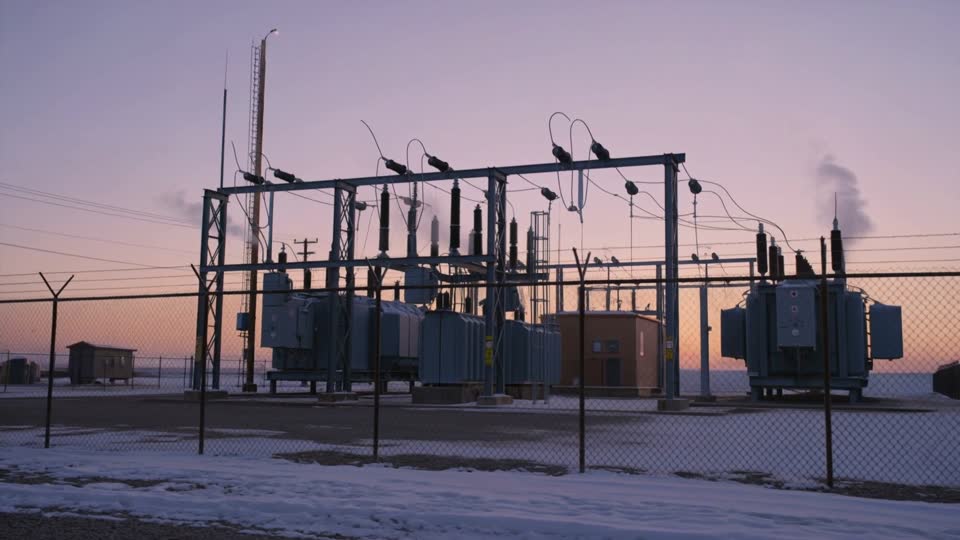
ENMAX Power owns the distribution wires in Calgary and charges its distribution tariff to every customer in its service area, whichever retailer sells them the energy. 1 It designs and builds the utility side: the primary line, the transformer and the service connection. The customer’s contractor installs everything from the service entrance onward, including the switchgear, the metering provisions and the distribution.
| Item | Normally supplied by | Note |
|---|---|---|
| Primary supply, transformer, utility connection | ENMAX Power | Priced by ENMAX estimate, less ENMAX investment |
| Meter socket or meter enclosure | Customer | Must be CSA-approved and customer-owned |
| Revenue meter and its connection | ENMAX Power | Contractors are restricted from handling meters |
| Switchgear, CT compartment provisions, feeders | Customer’s contractor | Designed to the ENMAX metering standard |
| Civil work, easements, access | Assign in writing | Often the gap between the two quotations |
The customer must provide, own and install a CSA-approved meter socket or enclosure. 2 ENMAX restricts electrical contractors from handling meters and cutting secondary supply connections. 3 ENMAX describes its service territory as Calgary and parts of Rocky View, Foothills and Tsuut’ina Nation. 4 Outside that area, confirm the wire owner before planning anything in this guide.
CCT 02The application, and why capacity comes first
Commercial work starts with ENMAX’s project intake request. ENMAX lists new service, service upgrade, temporary service, commercial feeder, relocation of its infrastructure and large load (above 1 MVA, or 720 kVA in the downtown core) as project types. For the request it asks for site, billing and on-site contacts, the new or upgraded service details (phase, amperage and voltage), a site plan and an electrical single-line diagram, which it requires for all commercial services. After submission ENMAX contacts the applicant for an initial consult, responds in priority sequence, and may need ENMAX or an electrical inspector to review the plan before work proceeds. It says location, operating characteristics, load forecast and timing all affect the cost and feasibility of a connection. 4
Do not assume a development permit settled the power question. When a development permit is circulated to ENMAX, ENMAX does not check or confirm that it has capacity for the proposed electrical service. 3 On infill and redevelopment sites the capacity answer can change the design, so ask early, while the building is still on paper.
The request is only as good as the load behind it. Base it on a qualified load calculation or on recorded demand from the existing meter, not on the size of the equipment list. The service capacity calculator shows the planning arithmetic, and the commercial service upgrades page covers the customer-side scope.
CCT 03Investment, contribution and the connection formula
ENMAX invests in new load up to a set level, and the customer contributes the rest of the cost of the service connection. The investment is a credit against ENMAX’s cost. It is not a price, and it is not what the customer pays.
For 2026, ENMAX invests $14,675 per meter for new small commercial (D200) load. 5 Medium and large commercial customers (D300 and D310) can instead take an investment per kVA of minimum contract demand: $367 on a 15-year agreement, $245 on a 10-year agreement or $122 on a 5-year agreement, up to 80% of anticipated maximum demand. 5 As arithmetic only: a hypothetical site anticipating 500 kVA of maximum demand could contract for up to 80%, or 400 kVA, and on a 15-year agreement that is 400 × $367 = $146,800 of ENMAX investment. The trade-off is a long commitment to pay for that demand.
When ENMAX changes its facilities for a changed service, such as an upgrade, the customer pays (A − B) + C − D + E + F. 6
| Term | Meaning |
|---|---|
| A | Estimated cost of removing the existing facilities |
| B | Salvage value of what is removed |
| C | Cost of installing the new facilities |
| D | ENMAX’s investment in the new load |
| E | 20% prepaid operation and maintenance on optional facilities |
| F | Other costs |
ENMAX gives a written estimate of the connection cost, its investment and the customer contribution, and breaks it down by component when the estimated cost exceeds $25,000. 6 If ENMAX reasonably believes a connection will be used for 2 years or less, it can treat it as temporary, refuse to invest and charge facilities, installation and removal less reusable material. 6 Every temporary construction service in Calgary also needs an HRC fused disconnect ahead of the meter. 3 How these pieces fit a budget is covered in the service upgrade and switchgear cost guide.
CCT 04CT metering over 200 A
Above 200 A, a service is too large to run through a self-contained meter. ENMAX requires a CT request form and a CT meter installation checklist for services rated over 200 A. 7 Current transformers sit in a compartment of the customer’s switchgear or a separate cabinet, and the meter reads a scaled-down current through them.
That makes metering a procurement issue. The CT compartment, its sealing provisions and the meter location have to match the ENMAX metering standard before the switchgear is released for manufacture. A drawing that has to be revised after the gear is built costs weeks. Settle it with the designer and ENMAX first, then order. The CT metering guide explains the arrangement, and the switchgear and transformers page covers the equipment.
Larger sites also get a different meter. ENMAX installs interval meters at new sites with a planned installed capacity of 150 kVA or more. 6 If an existing meter must be upgraded, ENMAX charges $128 an hour for single-phase work or $258 an hour for a two-person multi-phase crew, plus materials including the meter. 8
CCT 05Inspection before energization, and outage notice
Energization is a milestone with prerequisites, not a date on a calendar. A new or upgraded site must be approved by the electrical inspection authority, following the ENMAX metering standard, before ENMAX energizes it, and energization is requested through the retailer. 7 A new ENMAX Site ID can take up to 48 hours to become available to retailers, so set it up before the inspection, not after. 7
Upgrades to an occupied building need a planned outage. ENMAX needs at least 3 business days’ notice to schedule disconnect and reconnect work. 9 A customer-requested temporary disconnect is free, but re-energizing afterwards costs $166 an hour. 8 Before reconnecting, ENMAX may require an electrical permit number and a completed inspection, or an emailed authorization from the City’s electrical inspections department. 9
Two charges show why readiness matters. If energization fails because of deficient customer equipment, unsafe conditions or code non-compliance, ENMAX charges $90 for the extra trip, billed to the retailer. 8 Work the customer needs outside 7:00 a.m. to 4:00 p.m. on weekdays costs $352 an hour. 8 Night and weekend shutdowns are common in occupied buildings, so ask who carries those charges in each price.
Electrical safety
Only ENMAX removes or reinstalls meters and makes the utility connection. Treat every service entrance as energized until the utility and the contractor’s lockout procedure confirm otherwise. This guide describes sequence and responsibility, not how to do any of the work.
CCT 06Which rate class the site lands in
The connection sets up the delivery rate the site will pay for years. ENMAX’s schedule of rates in effect as of July 1, 2026 sorts commercial sites into classes by energy use and demand. 10
| Class | Who it covers | Demand billing |
|---|---|---|
| D200 Small Commercial | Under 5,000 kWh a month | None |
| D300 Medium Commercial | 5,000 kWh a month or more in 6 of the last 12 invoice periods, without 2 peaks above 150 kVA in 365 days | Per day, per kVA |
| D310 Large Commercial, secondary | Peaks above 150 kVA twice in 365 days, served at secondary voltage | Per day, per kVA |
| D410 | Served at primary voltage | Per day, per kVA |
D200 applies below 5,000 kWh a month. 10 D300 needs at least 5,000 kWh a month in 6 of the last 12 invoice periods, as long as a peak above 150 kVA was not registered twice in 365 days. 10 D310 applies once a site registers a monthly peak above 150 kVA twice in 365 days. 10 One spike does not move a site to D310. Two do.
Demand is billed in kVA, not kW. Billing demand is the greatest of metered, ratchet or contract demand, and the ratchet is 90% of the highest kVA demand in the last 365 days. 10 So a hypothetical site that peaks at 200 kVA in January is billed on at least 180 kVA for the following year. Charges are per day: the D300 service charge is $9.644493 a day, which works out to about $289 over a 30-day month (derived). 10 ENMAX also requires a power factor of at least 90%, and can require corrective equipment at the customer’s cost if a site falls short. 6 These are delivery charges only. Energy, the City’s local access fee and riders are billed on top.
CCT 07Buying the energy: retailer or Rate of Last Resort
The wires connection and the energy contract are separate decisions. A site whose annual consumption the distribution owner forecasts at under 250 MWh is eligible for the Rate of Last Resort, the regulated default rate. 11 That rate is fixed for 2 years at a time, with each later term’s adjustment capped at 10%, and its first term runs from January 1, 2025 to December 31, 2026. 11
A site forecast at 250 MWh a year or more is not eligible. It buys from a retailer, and if it cannot get or keep retail service, a default supplier must serve it. 12 In ENMAX Power’s Calgary area that default supplier is ENMAX Energy Corporation. 6 The 250 MWh test is the distribution owner’s forecast for the site, not a choice the customer makes.
Large new loads such as data halls, fleet charging depots and process equipment should be discussed with ENMAX as early as the site plan allows. See data centres and server rooms and workplace and fleet EV charging for how those loads change the conversation, and the commercial permits guide for the City approvals that run in parallel.
Questions people ask
How long does ENMAX take to connect power to a commercial building?
ENMAX publishes no standard duration for commercial connections. The timeline depends on capacity at the location, the design and estimate, the customer’s acceptance and payment, equipment readiness and the inspection. Energization cannot happen until the site passes inspection. 7 Start the intake request while the design is still flexible.
What is an ENMAX customer contribution?
It is the part of the connection cost ENMAX does not invest. For 2026 ENMAX invests $14,675 per meter for new D200 load, or a per-kVA amount for D300 and D310 customers who sign a minimum demand agreement. 5 The written estimate shows the cost, the investment and your share.
Does a commercial service over 200 A need CT metering?
Yes. ENMAX requires a CT request form and a CT meter installation checklist for services rated over 200 A. 7 The switchgear’s CT provisions must follow the ENMAX metering standard.
What is the difference between ENMAX D300 and D310?
Both bill demand per kVA. A site moves to D310 when it registers a monthly peak above 150 kVA twice in 365 days, and D310 has higher daily service and facilities charges. 10 The 90% ratchet then holds billing demand up for a year.
Does ENMAX charge a power factor penalty?
The rate schedule sets no separate power-factor charge. The terms require customers to keep power factor at 90% or better, and ENMAX can require corrective equipment at the customer’s expense. 6 Because demand is billed in kVA, poor power factor also raises billing demand.
Sources
- Tariffs and feesENMAX Power Corporation · retrieved 2026-09-25
- ENMAX Power Corporation Distribution Tariff Customer Terms and ConditionsENMAX Power Corporation · effective 2026-01-01
- Electrical permits for contractorsCity of Calgary · retrieved 2026-09-25
- Start a projectENMAX Power · retrieved 2026-09-27
- ENMAX Power Corporation Distribution Tariff, Terms and Conditions Investment Level ScheduleENMAX Power Corporation · Effective January 1, 2026 (applies January 1 to December 31, 2026)
- ENMAX Power Corporation Distribution Tariff, Customer Terms and ConditionsENMAX Power Corporation · Effective January 1, 2026
- Get the power flowingENMAX Power Corporation · retrieved 2026-09-25
- ENMAX Power Corporation Distribution Tariff, Terms and Conditions Fee ScheduleENMAX Power Corporation · Effective January 1, 2026
- Temporary disconnect / reconnectENMAX Power Corporation · retrieved 2026-09-25
- ENMAX Power Corporation Distribution Tariff Rate Schedule - rates in effect as of July 1, 2026ENMAX Power Corporation · Rates in effect as of July 1, 2026 (DAS/SAS rates per AUC Decision 30299-D01-2025, effective January 1, 2026); retrieved 2026-09-25
- Rate of Last Resort Regulation, Alta Reg 262/2005 (office consolidation)Alberta King's Printer · Consolidation current as of March 27, 2026 (amendments to AR 63/2026); retrieved 2026-09-25
- Roles, Relationships and Responsibilities Regulation, 2003, Alta Reg 169/2003 (office consolidation)Alberta King's Printer · Consolidation current as of April 14, 2021; retrieved 2026-09-25
Related
-
 E-401
Commercial electrical permits in Calgary
Base-building and tenant permits, drawings at 600 A and above, plans review, annual permits, inspections and occupancy.
-
 E-403
120/208 V vs 347/600 V
The two common Canadian commercial voltages: where each is used, why buildings choose 600 V, and what it means for equipment.
-
 E-404
Engineer vs contractor
When a commercial electrical job needs an engineer, what the contractor designs, and design-build versus design-bid-build.