Service · E-106
Commercial LED lighting retrofits in Calgary
Buy the lighting result first and calculate the saving second. A retrofit that cuts energy but leaves an aisle too dark or a parkade full of glare has not paid back.
CCT 01Start with a real inventory
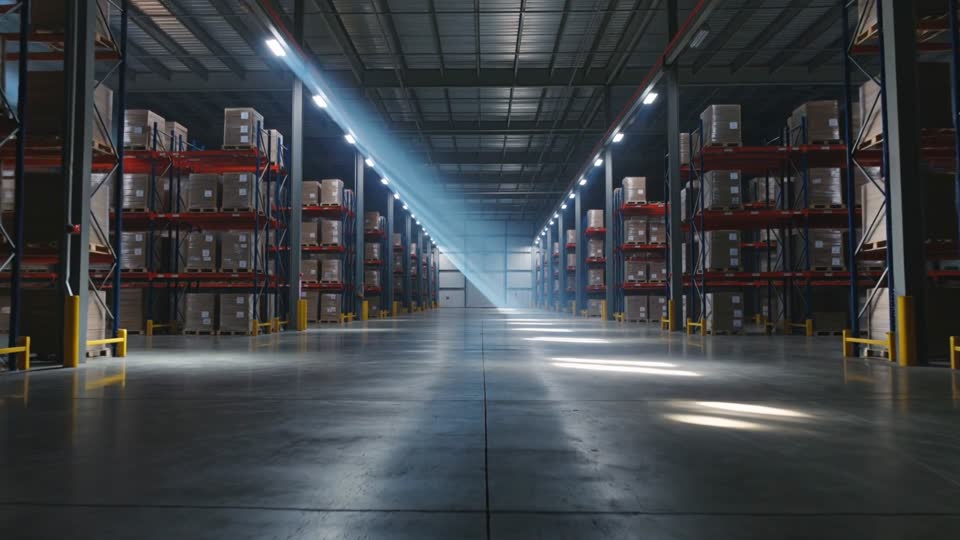
An LED retrofit is priced from a count, and the count is usually wrong until someone walks the building. Record each area’s fixture type, lamp and ballast, mounting height, switching, operating hours and condition. Commercial stock typically includes fluorescent troffers and strip lights in offices and stores, metal halide or fluorescent high-bays in warehouses and plants, enclosed fixtures in parkades, and wall packs and pole lights outside.
Operating hours matter as much as watts. A warehouse aisle lit around the clock, a parkade on constant burn and an office on a timeclock produce very different savings from the same fixture swap. Where lighting runs longer than anyone thinks, the evidence is in the controls or the bills, not the lease description. The LED retrofit payback calculator takes fixture counts, wattages and hours and shows the energy and demand saved.
Check the voltage too. In buildings distributed at 347/600 V, lighting commonly runs at 347 V, and that limits which drivers, kits and sensors are compatible. The 120/208 V vs 347/600 V guide explains why.
CCT 02Lamp, kit or new luminaire
| Approach | What is replaced | Watch for | Fits best where |
|---|---|---|---|
| LED tube on the existing ballast | Lamps only | Ballast compatibility; ballasts keep failing and keep drawing power | Short hold periods and fixtures in good condition |
| LED tube with ballast bypass | Lamps; ballast removed, lampholders rewired | Line voltage at the lampholders, labelling, certification of the modified fixture | Sound fixtures, where the owner accepts the rewiring |
| Retrofit kit | Internal components inside the existing housing | Certification for use as a retrofit, fit in the housing, labour | Good housings in finished ceilings |
| New luminaire | The whole fixture | Mounting changes, disposal volume, longer installation | Worn fixtures, high-bays, parkades, poles, or where the optics must change |
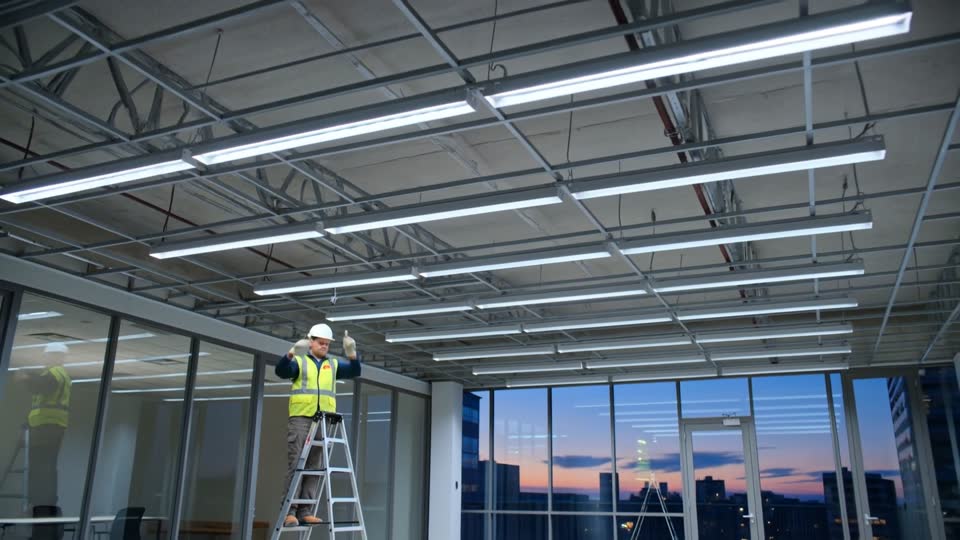
Whatever the approach, a modified fixture must remain acceptable as a certified product. Check that kits and bypass tubes are certified for the use and installed to their instructions, and keep that documentation; an insurer or inspector may ask for it.
CCT 03Scope and responsibility
| Item | Decided by | Done by | Confirm in the price |
|---|---|---|---|
| Fixture inventory and existing conditions | Owner commissions | Lighting designer or contractor | Who carries errors in the count |
| Light levels, uniformity, glare and colour | Owner, with the designer | Designer | The target, agreed before products are chosen |
| Product selection and substitutions | Owner approves | Contractor or designer proposes | Named approved alternates |
| Sample or mock-up area | Owner | Contractor | Worth including on large rollouts |
| Controls: sensors, dimming, schedules | Owner and designer | Electrical contractor and controls commissioning | Programming and commissioning effort |
| Emergency lighting and exit signs | Owner | Electrical contractor | Kept working, or replaced in the same scope |
| Lifts, access and after-hours work | Owner sets constraints | Contractor | Racking, parkade traffic, tenant hours |
| Disposal of lamps, ballasts and fixtures | Owner is accountable | Contractor or recycler | Disposal documentation |
| Incentive applications | Owner | Owner or consultant | Only if a program is actually open |
| Commissioning and measured hours | Owner | Contractor | Settings recorded at handover |
The scope most often missed is emergency lighting. Where normal fixtures also serve as emergency lighting, on a generator circuit or with battery packs, the retrofit must keep that function and its test regime. Self-contained emergency lighting units are tested monthly under NFC(AE) 6.5.1.6,1 and emergency lighting inspections should see the new units on the next visit.
CCT 04Energy code and permits
Alberta brought the National Energy Code of Canada for Buildings 2020 into force on May 1, 2024,2 and adopted its Tier 1 as the minimum energy-efficiency level for buildings outside Part 9.2 Whether the energy code applies to a particular retrofit, and which lighting power and control provisions follow, is for the designer and the authority having jurisdiction to settle for that project; do not assume either way from the word retrofit. An existing installation that met the code when it was installed generally does not have to be brought up to a new edition, although modifications can trigger current-code compliance.3
On permits, Calgary does not require an electrical permit when only fixtures are replaced,4 but it does require one for new wiring and for extending or altering circuits.4 Adding sensors, rezoning switching, running circuits to relocated fixtures or changing emergency lighting can cross that line, so confirm with the City. Where a permit is needed, the fee is $112 plus $9.79 per $1,000 of construction value.5 The permits guide has the detail, and lighting controls covers sensors, daylight harvesting and networked systems.
CCT 05Working out the saving on a Calgary bill
An LED retrofit saves energy (kWh) on every account, and demand (kVA) only on demand-billed accounts. Keep the components separate:
- Energy. The retailer’s price per kWh, or the Rate of Last Resort, which in ENMAX’s area is 12.06¢ per kWh fixed to December 31, 2026, for energy only.6 Add the variable delivery charges: on D200, a system usage charge of $0.013024 per kWh, alongside a fixed $1.734942 per day that does not change,7 and a transmission charge of $0.031577 per kWh.7
- Demand. D200 has no demand charge. On D300, D310 and D410, demand is billed per day per kVA, billing demand is the greatest of metered, ratchet and contract demand, and the ratchet is 90% of the highest kVA in the last 365 days.7 A retrofit that lowers the peak may not lower billing demand until the old peak ages out.
- Fixed charges. Service charges are per day and do not fall. D300’s is $9.644493 per day;7 30 days at that rate is about $289 (derived).
Time of use matters on large accounts. D310’s transmission charges are $0.349342 per day per kVA of billing demand, plus $0.012021 per kWh on-peak and $0.009074 off-peak,7 with on-peak running 8 a.m. to 9 p.m. on weekdays.7 Lighting that burns through business hours saves at the higher rate.
Then there is heat. Old fixtures give off heat that currently offsets some space heating, so removing it adds a little heating load in Calgary’s long heating season, which runs to 5,000 heating degree-days,8 while cutting cooling load in summer. That is one more reason to compare bills after the retrofit rather than attributing every change to it. The cost per square foot guide explains why per-area budgets hide these drivers.
CCT 06Incentives: confirm status before counting them
An incentive belongs in the payback only after its eligibility, availability and approval conditions have been checked. As read on 2026-09-25:
- Emissions Reduction Alberta’s Energy Savings for Business program has allocated all its funding.9
- ERA’s SEMI program is for industrial and manufacturing facilities: a $70 million program with waitlists open for all activities.10
- Calgary’s Commercial Clean Energy Improvement Program is paused.11 When open, it finances up to $1,000,000 through property tax, excluding industrial property and new builds,11 and it requires an ASHRAE Level II audit and CEIP-qualified contractors.11
An LED project that only works with an incentive should be re-tested without one. Industrial owners can ask ERA whether lighting fits within a SEMI project; do not assume it does.
CCT 07Access, sequencing and disposal
Installation cost is mostly access and logistics. Warehouses need lifts that fit between racking and a plan for working around forklifts; parkades need traffic control and stall closures; occupied offices need after-hours work or phased floors. Put the constraints in the tender, not in a change order.
Disposal belongs in the installed price. Fluorescent lamps contain mercury and older magnetic ballasts may contain PCBs, so both go to appropriate recycling or hazardous-waste handling, with documentation. Exterior and parkade fixtures also need a cold rating: Calgary’s January 1% design temperature is −32 °C,8 so check the driver’s rated operating temperature before approving a product for unheated space.
Wiring changes
Ballast bypass, kit installation and controls wiring are electrical work on circuits that often share panels with occupied areas. They need isolation and lockout by qualified workers, under a permit where one is required, and they are not a task for general facilities staff. This page is planning information, not installation instructions.
CCT 08Where retrofits pay, and what to keep
Retrofits pay best where lights burn longest: warehouses and distribution, condo and apartment parkades, and common areas that property managers light around the clock. As of 2026-09-25 the City’s business licence data listed 2,237 licensed warehousing and wholesale premises in Calgary.12 Contains information licensed under the Open Government Licence – City of Calgary.
At handover, keep the fixture schedule with model numbers, certification documents for kits, warranty terms, control settings and schedules, disposal records and the operating-hour assumptions used in the payback. Compare bills against those assumptions only after enough months have passed to cover a heating season and the demand ratchet.
Questions people ask
What is an LED retrofit kit?
A set of LED components (light engine, driver and mounting hardware) designed to be installed inside an existing fixture housing, turning it into an LED luminaire without replacing the housing. It suits finished ceilings where the housing is sound. The kit should be certified for use as a retrofit and installed to its instructions so the modified fixture remains acceptable.
Should I choose ballast bypass or plug-and-play LED tubes?
Plug-and-play tubes are quick to install but keep the old ballast, which still fails and still draws power. Ballast bypass removes the ballast and rewires the lampholders to line voltage. It is more efficient over time but it is electrical work, and the fixture must be clearly labelled so nobody later fits a fluorescent tube. On a large rollout, compare both against kits and new luminaires on a sample area before committing.
Does an LED lighting retrofit need a permit in Calgary?
Replacing fixtures only does not need an electrical permit in Calgary,4 but new wiring and extending or altering circuits do.4 Controls, rezoning, relocations and emergency lighting changes can involve altered circuits. Where a permit is needed, the fee is $112 plus $9.79 per $1,000 of construction value, plus the Safety Codes Council fee.5
How do I work out LED retrofit payback?
Simple payback is project cost divided by annual savings. Savings come from kWh saved (watts removed multiplied by operating hours) at your energy and variable delivery rates, plus demand savings only if the account is demand-billed and the peak actually falls. Leave out fixed daily charges, which do not change, and leave out incentives unless one is open and approved.
What are the lighting requirements for a parking garage?
Parkade lighting is governed by the building code, the energy code, the fire code’s emergency lighting provisions and the owner’s security standard. The design target should come from a lighting designer for that building, not a generic figure. In a retrofit, keep emergency lighting and exit signs working and on their test schedule, confirm fixtures are rated for unheated space, and consider occupancy-based dimming.
Sources
- Fire Safety Maintenance Requirements (Calgary Fire Department Inspections)The City of Calgary (Calgary Fire Department) · Latest revision May 1, 2024 (NFC(AE) 2023); retrieved 2026-09-25
- Notice: New Alberta codes editions (NBC(AE) 2023, NFC(AE) 2023, NECB 2020)Alberta Municipal Affairs · April 2024
- STANDATA bulletin 24-ECB-000 Object, scope, and definitionsAlberta Municipal Affairs · April 2025
- Homeowner electrical and plumbing permitsCity of Calgary · retrieved 2026-09-25
- 2026 Building & Trade Permit Fee Schedule (R2026-02)The City of Calgary · 2026 fee schedule, revision R2026-02; retrieved 2026-09-25
- Utilities Consumer Advocate: Default ratesGovernment of Alberta (Utilities Consumer Advocate) · Fixed 2025-01-01 to 2026-12-31; page read 2026-09-25
- ENMAX Power Corporation Distribution Tariff Rate Schedule - rates in effect as of July 1, 2026ENMAX Power Corporation · Rates in effect as of July 1, 2026 (DAS/SAS rates per AUC Decision 30299-D01-2025, effective January 1, 2026); retrieved 2026-09-25
- National Building Code - 2023 Alberta Edition, Volume 1, Division B, Appendix C, Table C-2 Climatic Design Data for Selected Locations in AlbertaAlberta Municipal Affairs / National Research Council of Canada · 2023 Alberta Edition, second printing incl. revisions and errata released April 2026
- Energy Savings for BusinessEmissions Reduction Alberta · retrieved 2026-09-25
- Strategic Energy Management for Industry (SEMI)Emissions Reduction Alberta · retrieved 2026-09-25
- Commercial Clean Energy Improvement ProgramCity of Calgary · Page read 2026-09-25
- Calgary Business Licenses (dataset vdjc-pybd)The City of Calgary, Open Government Licence – City of Calgary · queried 2026-09-25
Related
-
E-101
Tenant improvements
Office, retail and restaurant fit-outs: what the base building provides, what the tenant’s electrical scope covers, the drawings and the permits.
-
 E-102
Commercial service upgrades
Raising a building’s service: capacity checks, the ENMAX application and investment, CT metering, drawings and the shutdown.
-
 E-103
Three-phase power
New three-phase services and single-to-three-phase conversions for equipment, kitchens, shops and EV charging.