Service · E-108
Commercial generators and automatic transfer switches in Calgary
Decide which loads must run through an outage, and why, before anyone sizes a generator. That design basis sets the code path, the equipment and the testing that follows.
CCT 01Emergency power or standby power: settle the basis first
“Backup generator” covers two different things, and a project that mixes them up gets redesigned.
- Emergency power serves life-safety loads where the building code requires it: emergency lighting, the fire alarm, fire pumps, smoke control, and elevators that firefighters use. It follows the electrical code’s rules for emergency systems, the fire code’s maintenance requirements and CSA C282 for the supply itself.
- Optional standby power keeps a business running: refrigeration, servers, heating, production lines, parkade doors, a restaurant’s kitchen. The owner chooses what it carries and how long it must run.
Many buildings have both on one generator, with separate transfer switches and separate distribution so that a standby fault cannot take down the emergency loads. Whether a building needs emergency power at all, and for which loads, is set by the building code for its height, occupancy and systems. The designer confirms that at the start, because it changes the wiring methods, the transfer equipment, the fuel arrangements and the testing the owner signs up for.
A generator also needs time to start and pick up load. Loads that cannot tolerate any interruption, such as servers and some medical or process controls, need a UPS in front of them, and the generator then carries the UPS. Anyone looking at a generator for a house should read the residential guidance at CalgaryElectricians.ca; this page covers commercial, industrial and multi-family buildings.
CCT 02Building the load list and sizing the set
Generator size comes from a load list, not from the service rating. For each load the designer needs the running kW and kVA, the starting behaviour and whether it must start at once or can follow in a later step. Several loads drive the size more than their running power suggests:
- Motors draw several times their running current at start; large fans, pumps and compressors are usually started in steps.
- Elevators start under load and can push regenerated energy back towards the generator.
- Drives, UPS systems and LED drivers add harmonic current, which heats the alternator and can upset voltage regulation.
- Heating in a Calgary winter can be the largest load in the building.
For whole-building standby, measured demand beats estimates. ENMAX installs interval meters at sites planned at 150 kVA or more and at existing sites once demand registers 150 kVA or more twice in twelve months,1 and that interval history shows the real peak and when it happens. The generator sizing calculator turns a load list into kW and kVA, and the three-phase calculator converts between kVA and amps at 120/208 V and 347/600 V.
CCT 03Automatic transfer switches and how they connect
The transfer switch decides when the building leaves the utility and when it returns. The choices that matter:
- Automatic or manual. Emergency loads need automatic transfer. A manual transfer switch, or a connection box for a rental generator, can suit optional standby loads where someone is on site to operate it.
- Transition type. Open transition breaks from one source before making the other. Delayed transition pauses at off, which protects motor loads. Closed transition parallels the generator with the utility for a moment so loads do not see a break on the return, and that brings ENMAX into the design.
- Service-entrance rating. A transfer switch at the service can serve as the service disconnect, avoiding a separate device, but its installation means shutting down the whole building.
- Bypass-isolation. Critical sites use switches that can be bypassed so the transfer mechanism can be maintained without an outage.
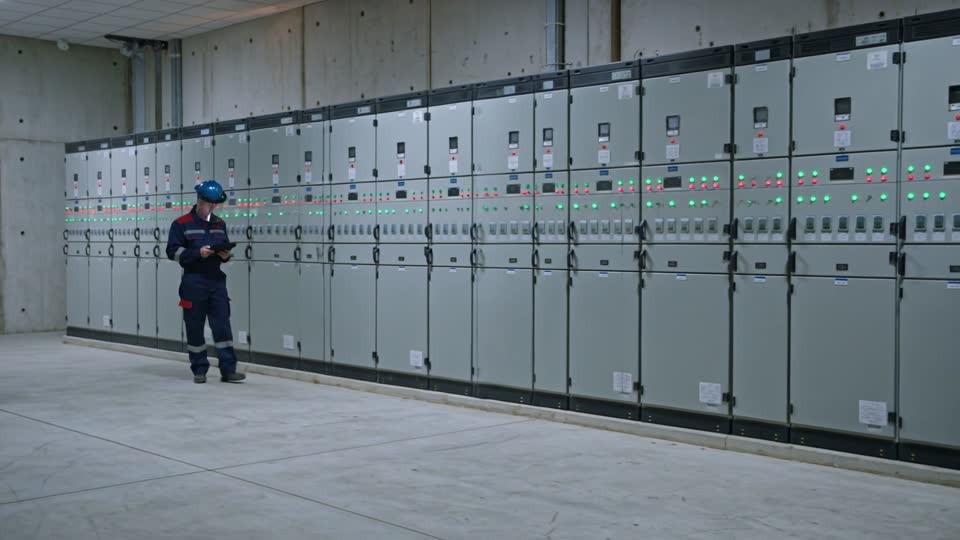
Adding a generator changes the fault current and the operating modes of the distribution system, so the protective device coordination and any arc flash study should be updated with it. Where the new transfer switch sits in a switchboard lineup, the work overlaps with switchgear and transformer replacement.
On small services, meter-mounted transfer equipment has been installed under an Alberta variance. That variance will be archived on January 1, 2027, after which new units must be certified to ANSI/CAN/UL 1008M:2025.2
CCT 04Who does what on a generator project
| Item | Usually decided or supplied by | Electrical contractor’s part | Settle before pricing |
|---|---|---|---|
| Design basis: emergency, standby or both | Owner with the electrical engineer | Reviews for buildability | Which loads, which branch, how long |
| Generator set and enclosure | Engineer specifies; supplier or contractor provides | Sets, connects and grounds | Fuel type, enclosure, sound level, lead time |
| Transfer switches | Engineer | Supplies and installs | Number, rating, transition type, bypass |
| Pad, roof structure, crane lift | Structural engineer and general contractor | Coordinates conduit stub-ups | Location, loading and access |
| Fuel: natural gas or diesel tank | Mechanical designer; gas fitter | Not usually | Separate gas permit, tank rules, fuel duration |
| Exhaust, air intake, ventilation | Mechanical designer | Power to dampers and heaters | Route, clearances, snow and wind exposure |
| Feeders and distribution changes | Engineer | Installs under permit | Separating emergency and standby branches |
| Fire alarm and BAS interfaces | Engineer; fire alarm vendor | Wiring and pathways | Remote annunciation and alarms |
| Utility tie-in and shutdown | Owner books; ENMAX disconnects | Plans and performs the tie-in | Date, notice, off-hours charges |
| Commissioning and load bank test | Engineer witnesses | Supports supplier’s start-up | Test loads, acceptance criteria |
| Maintenance and testing contract | Owner | Sometimes | Who does monthly, annual and longer-interval tasks |
Fuel is the row most often missed. Natural gas needs a gas trade permit of its own, separate from the electrical permit,3 and the gas utility must confirm the supply can carry the generator on top of the building’s heating on the coldest day.
CCT 05Permits, ENMAX and the tie-in shutdown
A generator installation needs an electrical permit for the new wiring and altered circuits,4 and only a master electrician can obtain one.5 The fee is $112 plus $9.79 for every $1,000 of construction value,6 and construction value includes labour and material, customer-supplied equipment included.6 That makes the generator itself part of the fee base when the permit covers it. Where the project includes a service or distribution change of 600 A or more, Calgary requires plans,7 and the single-line diagram must show the fault current at every overcurrent device.7 Ask the City whether an outdoor enclosure, rooftop support or fuel tank also needs a building or development permit.
Connecting a transfer switch at the service means a planned outage, and only ENMAX can disconnect its supply: contractors are restricted from handling meters and cutting secondary supply connections.7 ENMAX needs at least 3 business days’ notice for disconnect and reconnect work.8 A customer-requested temporary de-energization is free,9 re-energization costs $166.00 per hour,9 and work the customer needs outside 7:00 a.m. to 4:00 p.m. on weekdays is charged at $352.00 per hour.9 Before reconnecting, ENMAX may need the permit and a completed inspection, or an authorization from the City’s electrical inspections.8 The ENMAX commercial connection guide and the commercial permits guide cover both processes.
Backfeed and tie-ins
An improperly connected generator can energize the utility system or a “dead” building circuit. Tie-ins belong in a planned shutdown with the supply isolated and locked out by qualified workers, and closed-transition or paralleling schemes need the utility’s review. Nobody should work on energized service equipment to avoid an outage. This page is planning information, not installation instructions.
CCT 06Siting a generator for a Calgary winter
A standby generator is most likely to be needed in the conditions that make it hardest to start. The Alberta building code gives Calgary a January 2.5% design temperature of −30 °C10 and a January 1% value of −32 °C.10 The design should show how the set starts and accepts load at those temperatures:
- engine block heaters, a battery charger and battery warmers, each on a circuit that stays energized, and a way to see that they are working;
- enclosure heating and louvres that close when the set is off;
- for diesel, fuel suited to cold weather and a tank location that avoids waxing; for natural gas, supply pressure that holds when every furnace in the area is running;
- air intake and exhaust placed clear of drifting snow, and away from windows and building air intakes;
- a cleared route for fuel delivery and service vehicles in winter.
Rooftop sets avoid grade-level snow and vandalism but add structural and crane costs and a harder service route. Grade-level sets need space, protection from vehicles and, in parkades, ventilation that works with the building’s.
CCT 07Testing and maintenance under CSA C282
Emergency generators come with a testing calendar the owner must keep. Calgary Fire Department’s maintenance guide says the National Fire Code, 2023 Alberta Edition, requires emergency generators to be maintained to CSA C282-15, with monthly, 6-month, annual and 5-year inspection, testing and maintenance.11 CSA’s current edition is C282:24, which supersedes the 2019 and 2015 editions.12 Follow the edition the fire code references, and ask the service provider to name it on each report. The owner, or the owner’s authorized agent, is responsible for carrying out the fire code’s maintenance provisions.11
Load bank testing comes up because a monthly run on building load may barely load the engine. A diesel run lightly for long periods can build up unburnt fuel in the exhaust, and a light test also proves little about its ability to carry the building. A portable load bank, connected at a load bank connection point if the design provides one, applies a controlled load. Whether and when the standard requires one depends on the edition and the load the set sees in normal tests, so have the provider cite the clause rather than rely on a website’s interval.
Keep the logs where the next inspector and the next manager can find them. Generators are usually tested on the same calendar as the rest of the life-safety systems, covered under fire alarm and emergency lighting inspections.
CCT 08What moves the price, and who buys it
No federal, Alberta or Calgary source publishes generator or transfer switch prices. The number follows these drivers:
- the kW rating, fuel type, enclosure and sound attenuation;
- the number, rating and type of transfer switches, and whether one is service-entrance rated;
- distribution changes to separate emergency and standby loads;
- civil and structural work: pad, crane lift, roof reinforcement;
- fuel system, exhaust and ventilation work by other trades;
- engineering, permits, the ENMAX shutdown and any off-hours charges;
- commissioning, load bank testing and the first maintenance contract;
- equipment lead times, which set the schedule and sometimes the choice of unit.
Statistics Canada’s price index for the electrical division of Calgary non-residential buildings was 111.3 in the second quarter of 2026 (2023 = 100).13 It measures contractors’ input costs, not the price of a generator. The generator and transfer switch cost guide explains the drivers in more detail.
The buyers differ in what they protect. Data centres and server rooms need UPS coordination and redundancy; healthcare and clinics need to know which loads the code treats as essential; and condo and apartment buildings usually carry life-safety loads plus whatever the board chooses to add, such as sump pumps and parkade doors.
Questions people ask
What is the difference between an emergency generator and a standby generator?
An emergency generator supplies the life-safety loads the building code requires, such as emergency lighting, the fire alarm and fire pumps, and it comes with code-mandated testing under the fire code and CSA C282. A standby generator carries loads the owner chooses for business continuity. One set can do both, with separate transfer switches and distribution.
What is CSA C282?
It is the Canadian standard for emergency electrical power supply for buildings, covering installation, testing and maintenance of emergency generators. The current edition is CSA C282:24, the eighth.12 Calgary Fire Department’s maintenance guide still cites C282-15 as the edition the fire code references,11 so confirm which edition applies to your building.
How often does a commercial generator need to be tested?
For emergency generators, Calgary Fire Department’s guide lists monthly, 6-month, annual and 5-year inspection, testing and maintenance under CSA C282.11 The tasks and load requirements at each interval are in the standard; ask the service provider to cite the edition and clause they test to. Standby-only generators have no fire code calendar, but the same routine protects the investment.
Do I need a permit to install a commercial generator in Calgary?
Automatic transfer switch or manual transfer switch?
Life-safety loads need automatic transfer, because nobody can be relied on to throw a switch during a fire or at night. A manual transfer switch, or a connection point for a rental generator, can suit optional standby loads where trained staff are on site and a delay is acceptable. The choice also affects the permit drawings and the testing routine.
How much does an automatic transfer switch cost to install?
No official source publishes a price. The installed cost follows the switch’s current rating and transition type, whether it is service-entrance rated, bypass-isolation, the distribution changes around it, the ENMAX shutdown and any off-hours work, which ENMAX charges at $352.00 per hour.9 Compare bids on the same single-line diagram.
Sources
- ENMAX Power Corporation Distribution Tariff - Customer Terms and ConditionsENMAX Power Corporation · Effective January 1, 2026; retrieved 2026-09-25
- Notice to archive 24-ECV-002-024-MMTE: Meter mounted transfer equipmentAlberta Municipal Affairs · July 2026
- Changes to existing buildingsThe City of Calgary · retrieved 2026-09-25
- Homeowner electrical and plumbing permitsCity of Calgary · retrieved 2026-09-25
- About Master ElectriciansSafety Codes Council · retrieved 2026-09-25
- 2026 Building & Trade Permit Fee Schedule (R2026-02)The City of Calgary · 2026 fee schedule, revision R2026-02; retrieved 2026-09-25
- Electrical permits for contractorsCity of Calgary · retrieved 2026-09-25
- Temporary disconnect / reconnectENMAX Power Corporation · retrieved 2026-09-25
- ENMAX Power Corporation Distribution Tariff, Terms and Conditions Fee ScheduleENMAX Power Corporation · Effective January 1, 2026
- National Building Code - 2023 Alberta Edition, Volume 1, Division B, Appendix C, Table C-2 Climatic Design Data for Selected Locations in AlbertaAlberta Municipal Affairs / National Research Council of Canada · 2023 Alberta Edition, second printing incl. revisions and errata released April 2026
- Fire Safety Maintenance Requirements (Calgary Fire Department Inspections)The City of Calgary (Calgary Fire Department) · Latest revision May 1, 2024 (NFC(AE) 2023); retrieved 2026-09-25
- CSA C282:24 Emergency electrical power supply for buildings (store listing)CSA Group · retrieved 2026-09-25
- Table 18-10-0289-01 Building construction price indexes, by type of building and divisionStatistics Canada · Q2 2026 (April-June 2026); released 2026-07-24
Related
-
 E-101
Tenant improvements
Office, retail and restaurant fit-outs: what the base building provides, what the tenant’s electrical scope covers, the drawings and the permits.
-
E-102
Commercial service upgrades
Raising a building’s service: capacity checks, the ENMAX application and investment, CT metering, drawings and the shutdown.
-
 E-103
Three-phase power
New three-phase services and single-to-three-phase conversions for equipment, kitchens, shops and EV charging.