Guide · E-403
120/208 V vs 347/600 V: which one your building has, and why
Most Canadian commercial buildings run on one of two three-phase systems. The choice sets the current in every feeder, the size of the copper, the lighting voltage and which equipment can be plugged in without a transformer.
This explainer is for owners, facility managers, tenants and buyers of equipment who keep meeting the two numbers on nameplates, drawings and quotes. The arithmetic below is illustrative. The design of any real installation, including conductor sizes, protection and voltage drop, belongs to a qualified designer working to the code in force.
CCT 01What the two numbers mean
Both systems are three-phase, four-wire wye supplies: three phase conductors and a neutral. The first number is the voltage from any phase to neutral. The second is the voltage between any two phases. In a balanced wye the two are linked by the square root of three, about 1.732.
| System | Phase to neutral | Phase to phase | Check: phase to phase ÷ 1.732 |
|---|---|---|---|
| 120/208 V | 120 V | 208 V | 208 ÷ 1.732 = 120.1 V |
| 347/600 V | 347 V | 600 V | 600 ÷ 1.732 = 346.4 V |
So 347 V is not an odd standard. It is simply the phase-to-neutral voltage of a 600 V wye system, in the same way that 120 V is the phase-to-neutral voltage of a 208 V system. The US equivalent of 347/600 V is 277/480 V, which is why American equipment, calculators and articles talk about 480 V.
A 120/208 V system is not the same as the 120/240 V single-phase supply in a house. Two phases of a 208 V wye give 208 V between them, not 240 V. That difference matters for equipment rated 240 V, covered below. For homes and 120/240 V questions, CalgaryElectricians.ca is the residential reference.
CCT 02The arithmetic: the same power at a third of the current
For a balanced three-phase load, current equals apparent power divided by 1.732 times the phase-to-phase voltage. Because 600 V is about 2.88 times 208 V, the same load draws about 2.88 times less current at 600 V.
| Load | At 208 V | At 600 V | Ratio |
|---|---|---|---|
| 100 kVA | 277.6 A | 96.2 A | 2.88 |
| 500 kVA | 1,387.9 A | 481.1 A | 2.88 |
The working for the first row: 100,000 ÷ (1.732 × 208) = 277.6 A, and 100,000 ÷ (1.732 × 600) = 96.2 A. These are examples, not typical building loads. The three-phase kVA and amps calculator runs the same conversion in both directions for either voltage.
The same relationship sits behind utility billing. ENMAX bills commercial demand in kVA rather than kW, and billing demand is the greatest of metered, ratchet or contract demand, with the ratchet set at 90% of the highest demand in the last 365 days. 1 A site that knows its peak in kVA can move easily between amps, kVA and its bill.
Amps and volts are different questions. Calgary requires plans and drawings for services of 600 A and higher. 2 That is a current rating. A 400 A service can be a 600 V service, and a 600 A service can be a 208 V service.
CCT 03Feeders, voltage drop and losses
Lower current is the main reason larger buildings distribute at 600 V. Three consequences follow, each worked here for the same conductor over the same length.
- Voltage drop in volts. Drop is proportional to current. At about 2.88 times less current, the drop in volts is about 2.88 times smaller.
- Voltage drop as a percentage. That smaller drop is also measured against a system voltage about 2.88 times higher, so as a share of the supply it is about 2.88 × 2.88 = 8.3 times smaller.
- Heat lost in the conductor. Losses rise with the square of the current, so they are also about 8.3 times lower.
In practice designers take the benefit as smaller conductors, fewer parallel sets, smaller conduit and longer feasible runs, rather than as a lower percentage drop. That is why a warehouse with a long distance from the electrical room to the far wall, or a tower with risers climbing many floors, is normally a 600 V building.
The code sets limits on voltage drop for feeders and branch circuits (Rule 8-102 of the Canadian Electrical Code), and the designer checks them for the actual loads and routes. The code in force in Alberta is CSA C22.1-24, the 26th edition, in force since April 1, 2025. 3 Nothing in this page replaces that calculation.
CCT 04Where each system shows up
120/208 V suits buildings where most of the load is receptacles, small equipment and modest lighting: small offices, strip-mall retail bays, many restaurants, clinics and apartment suites. Everyday 120 V loads connect phase to neutral, and 208 V single- and three-phase equipment connects between phases, all without a transformer.
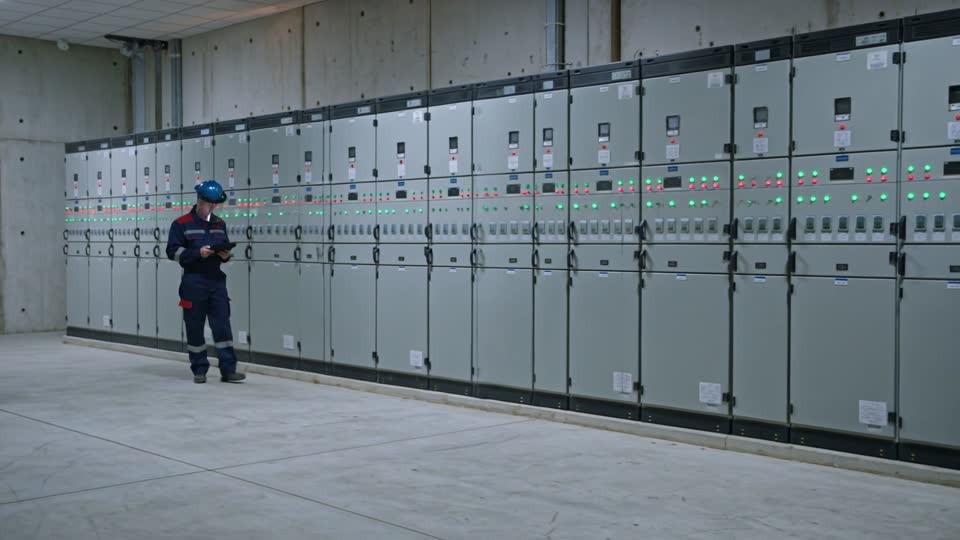
347/600 V suits buildings with large motor loads, long feeder runs or a lot of lighting: office towers, big-box retail, warehouses, plants and large multi-family buildings. Motors, rooftop units, chillers and elevator drives connect at 600 V, lighting at 347 V, and step-down transformers feed the 120/208 V panels that serve receptacles.
Many larger buildings are both. The service and main distribution are 600 V, and each floor or tenant area has a dry-type transformer and a 120/208 V panel. A tenant taking space in such a building inherits that arrangement. For how it plays out by building type, see warehouses and logistics, office buildings and restaurants and commercial kitchens.
CCT 05Why 347 V lighting
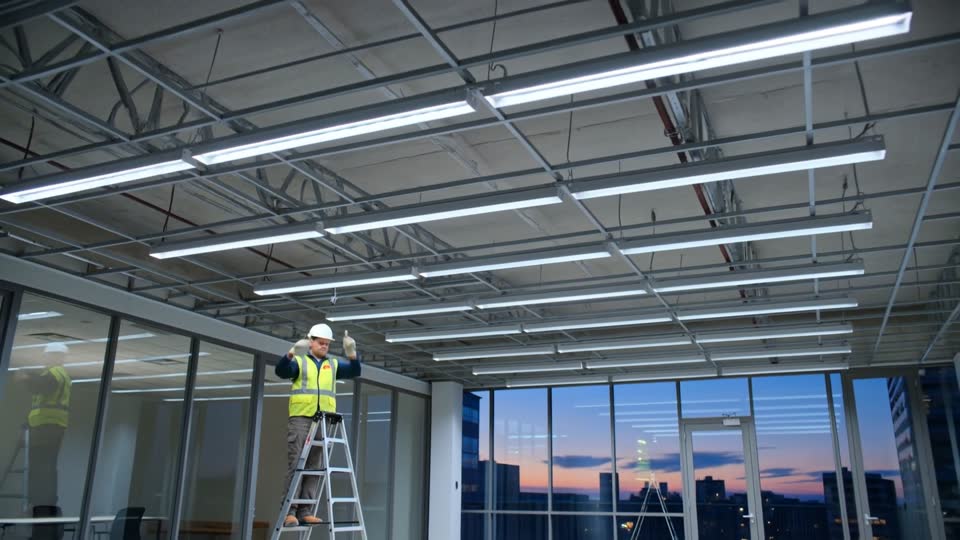
In a 600 V building, lighting can run at 347 V straight from the 600 V distribution, phase to neutral, with no transformer in between. Each 347 V circuit carries a lot more lighting than a 120 V circuit at the same current, so a floor of fixtures needs fewer circuits, fewer home runs and less copper, and the lighting load stays off the transformers that feed the receptacles.
The trade-offs are practical. Fixtures, LED drivers, sensors and switching devices must be rated for 347 V, and a 120 V product will not survive on a 347 V circuit. The code puts extra conditions on 347 V luminaires and their switching, which the designer applies. Maintenance staff need to know which circuits are 347 V before replacing a fixture or a control.
Retrofits are where this bites. A LED lighting retrofit in a 600 V building usually needs 347 V drivers or fixtures, and lighting controls must be compatible with the voltage, so confirm the circuit voltage before buying product.
Electrical safety
A 347 V lighting circuit is a 600 V system. It is not a household lighting circuit, and a lighting switch or fixture that looks ordinary can be at 347 V to ground. Leave fixture, driver and control changes to qualified electricians working under a lockout procedure. This page explains the system; it gives no instructions for working on it.
CCT 06Step-down transformers: the cost of having both
A 600 V building still needs 120 V for receptacles and office equipment, so it adds transformers. Each one is a piece of equipment with a price, a footprint, working clearances, heat to remove from the room, primary and secondary protection and its own maintenance.
The current changes across the transformer by the voltage ratio. As arithmetic for a hypothetical 75 kVA transformer from 600 V to 120/208 V: the primary draws 75,000 ÷ (1.732 × 600) = 72.2 A and the secondary can deliver 75,000 ÷ (1.732 × 208) = 208.2 A. Choosing the kVA rating is a load question, not a panel-size question, and the calculator shows the next standard size above a given load.
Transformers also shape fault current and coordination downstream, so replacing or adding one belongs in a design, not a swap. The switchgear and transformers page covers replacement, lead times and shutdown planning.
CCT 07Equipment, conversions and the system you already have
For an existing building, the system is a given. Start every equipment purchase with the nameplate: voltage, phase, frequency and full-load current. Three situations cause most problems.
- 240 V equipment on 208 V. A resistive heater rated 240 V delivers power in proportion to the square of the voltage, so on 208 V it gives about (208 ÷ 240)² = 75% of its rated output. Motors and controls may not tolerate the lower voltage at all. Buy 208 V-rated equipment for a 208 V building.
- US 480 V equipment in a 600 V building. 480 V and 600 V are different systems. Imported machinery needs a transformer or a Canadian-voltage version, and must carry an acceptable Canadian certification mark.
- 575 V nameplates. Motors intended for 600 V systems commonly carry a 575 V utilization rating that allows for voltage drop. Check it against the system rather than assuming a mismatch.
For a new building, the system is chosen at design with the utility, together with the service size and the transformer arrangement. Changing it later means a new service, so it is rarely done. The steps are in the ENMAX commercial service connection guide, and adding three-phase supply to a building that lacks it is covered on the three-phase power service page and the three-phase power cost guide.
Questions people ask
What does 347/600 V mean?
It describes a three-phase wye supply with 347 V between each phase and neutral and 600 V between any two phases. The 347 V figure is 600 V divided by the square root of three. It is the most common supply for larger Canadian commercial and industrial buildings.
Why do Canadian buildings use 347 V lighting?
Because 347 V is available directly from a 600 V system without a transformer. Each lighting circuit carries more fixtures at the same current, which cuts circuits, copper and transformer load. Fixtures, drivers and controls must be rated for 347 V.
Is 600 V the same as 480 V?
No. 480 V (277/480 V) is the common US commercial system, and 600 V (347/600 V) is the Canadian one. Equipment built for 480 V needs a transformer or a 600 V version to work in a 600 V building.
Is 120/208 V the same as 120/240 V?
No. 120/208 V is three-phase, and two of its phases give 208 V between them. 120/240 V is the single-phase split supply found in houses. A 240 V heater on 208 V gives about 75% of its rated output, and some equipment will not run correctly.
Can I use 208 V equipment in a 600 V building?
Yes, through a step-down transformer and a 120/208 V panel, which many 600 V buildings already have on each floor. Whether there is spare transformer and panel capacity for the new load is a separate question for a qualified assessment.
Sources
- ENMAX Power Corporation Distribution Tariff Rate Schedule - rates in effect as of July 1, 2026ENMAX Power Corporation · Rates in effect as of July 1, 2026 (DAS/SAS rates per AUC Decision 30299-D01-2025, effective January 1, 2026); retrieved 2026-09-25
- Electrical permits for contractorsCity of Calgary · retrieved 2026-09-25
- Electrical codes and standardsGovernment of Alberta · retrieved 2026-09-25
Related
-
 E-401
Commercial electrical permits in Calgary
Base-building and tenant permits, drawings at 600 A and above, plans review, annual permits, inspections and occupancy.
-
 E-402
ENMAX commercial service connections
How a Calgary business gets a new or bigger service: the application, capacity, ENMAX’s investment, CT metering and energization.
-
 E-404
Engineer vs contractor
When a commercial electrical job needs an engineer, what the contractor designs, and design-build versus design-bid-build.