Cost guide · E-309
What a commercial LED lighting retrofit costs in Calgary
No public body publishes a price for a commercial LED retrofit, and a per-fixture number from a sales page hides most of what you are buying. The cost is built from a handful of drivers, and the saving from published ENMAX tariffs, so both can be checked line by line.
CCT 01Why this page has no price per fixture
This site publishes a price only when an official source does, and none publishes one for commercial LED retrofits in Calgary. Supplier pages quote per-fixture or per-square-foot figures without saying what is included, and the spread between them is mostly scope: whether the fixture is replaced or gutted, whether controls are added, who supplies the lift, and whether disposal and emergency lighting are in or out.
What can be checked is the saving. ENMAX Power’s distribution tariff and the Rate of Last Resort are published, so the value of each kilowatt-hour and each kVA removed can be calculated from cited rates, as this page does below. The LED retrofit payback calculator runs the same arithmetic on your own fixture counts.
| Cost line | What drives it | Usually carried by |
|---|---|---|
| Survey and fixture inventory | Building size, record drawings, access to ceilings | Contractor or lighting designer |
| Lighting design and photometrics | Whether light levels change or only sources change | Designer, or supplier on product-only jobs |
| Product: lamps, kits or luminaires | Approach chosen, product class, quantities | Contractor or owner-direct purchase |
| Installation labour | Per-fixture work, mounting height, obstructions | Electrical contractor |
| Lifts and access | Ceiling height, racking, parkade traffic, floor loading | Contractor, or owner if equipment is on site |
| After-hours or phased work | Occupancy, tenant hours, production schedules | Owner sets constraints; contractor prices them |
| Controls and commissioning | Sensor count, zoning, networked or standalone | Electrical contractor and controls specialist |
| Emergency lighting and exit signs | Battery packs, generator circuits, test regime | Electrical contractor |
| Disposal of lamps, ballasts and fixtures | Quantities, PCB ballasts, recycler documentation | Owner accountable; recycler or waste provider handles |
| Permit and inspection | Whether circuits are altered | Electrical contractor applies |
CCT 02Lamp swap, retrofit kit or new fixture
The approach sets most of the product and labour cost, and it also sets how long the saving lasts.
- Lamp swap on the existing ballast. The lowest installed cost per fixture and the fastest to install, but the ballast stays in the circuit, still draws power and still fails, so maintenance cost continues.
- Lamp with ballast bypass. Adds labour to rewire each fixture, removes the ballast load and failure point, and turns the retrofit into electrical work on every fixture.
- Retrofit kit. More product and labour than a lamp swap, keeps the housing and ceiling intact, and needs a kit certified for the use and installed to its instructions.
- New luminaire. The highest product cost and more disposal volume, but it resets fixture life and optics. It is often the only practical choice for worn high-bays, parkade fixtures and exterior poles.
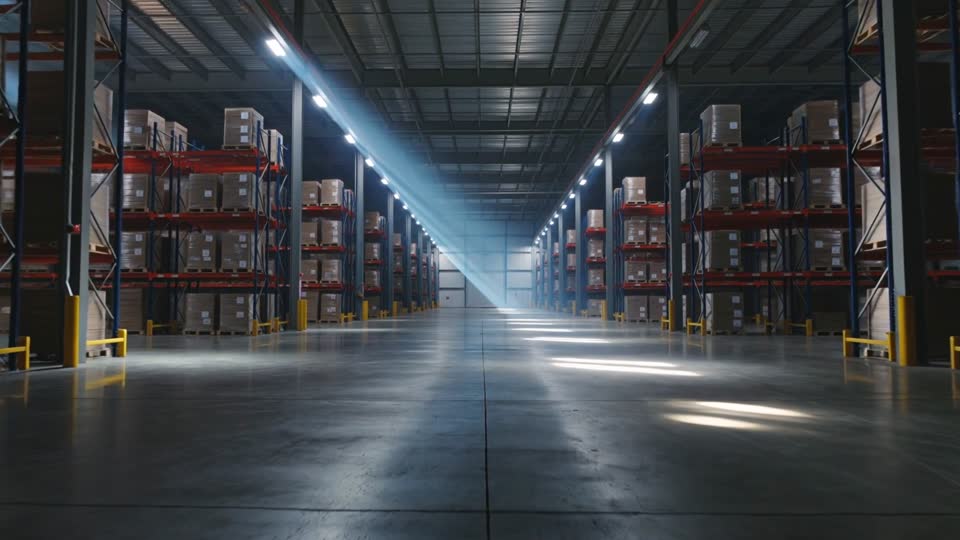
Mounting height is the biggest labour multiplier. A troffer in an office ceiling can be done from a ladder; a warehouse high-bay over racking needs a lift, a spotter and a plan for forklift traffic, and each fixture may take several times as long. Price high-bays, parkades and offices as separate lines. The LED lighting retrofits service page compares the approaches in detail.
CCT 03Controls, access and emergency lighting
Controls are often the difference between a retrofit that saves on paper and one that saves on the bill. Occupancy sensors, daylight dimming and schedules add product, wiring and commissioning time, and a networked system adds programming and a handover. Ask for controls as a separate line so the saving from sources and the saving from hours can be judged separately; lighting controls explains the options.
Access is the least visible cost. Lifts, parkade stall closures and traffic control, after-hours premiums and phased floors in occupied offices can outweigh product cost on some jobs. Put the working-hour and access constraints in the tender, so they are priced once rather than claimed later as extras.
Emergency lighting must survive the retrofit. Where normal fixtures double as emergency lights, on battery packs or a generator circuit, the replacements must keep that function. Self-contained emergency units are tested monthly under NFC(AE) 6.5.1.6,1 so the new units belong on the next emergency lighting inspection list.
CCT 04Disposal: mercury lamps and PCB ballasts
Disposal is a real cost line, and older buildings carry the larger version of it.
- PCB ballasts. Ballasts in fluorescent fixtures made before the 1980s usually contain high concentrations of PCBs. Under the federal PCB Regulations, light ballasts with a PCB concentration of 50 mg/kg or more have an end-of-use date of December 31, 2026, and once removed they may be subject to storage, labelling, destruction and reporting requirements.2 The owner of equipment containing PCBs is legally responsible for handling and disposal, PCB ballasts should be separated from non-PCB ballasts during a refit, and an electrical contractor that is not an authorized hazardous waste service provider should not transport, store or dispose of them.3
- Mercury lamps. Fluorescent tubes, compact fluorescents, metal halide, mercury vapour and sodium vapour lamps all contain mercury. Environment and Climate Change Canada’s code of practice for end-of-life mercury lamps is voluntary and aimed at the facilities and operators that collect, store, transport and process them.4 In practice, ask the bidder which recycler takes the lamps and ask for the receipt.
For a building with fluorescent fixtures of uncertain age, budget for identifying PCB ballasts before removal and for their separate handling. The date matters: equipment still in use after the end-of-use date needs the regulator’s approval to continue.2
Handling ballasts and wiring
Removing ballasts, bypassing them or installing kits is electrical work on live building circuits. It needs isolation and lockout by qualified workers. Leaking ballasts need handling by people trained for PCB materials. This page is cost information, not work instructions.
CCT 05Permits, labour and dating an old quote
In Calgary, replacing fixtures only does not need an electrical permit,5 but new wiring and extending or altering circuits do.5 Bypass rewiring, new sensor circuits or relocated fixtures can cross that line; the permits guide covers how to confirm it. Where a permit is needed, the fee is $112 plus $9.79 per $1,000 of construction value,6 plus a Safety Codes Council fee of 4% of the permit fee, with a $4.50 minimum and $560 maximum.6
As arithmetic on that formula, a hypothetical $50,000 retrofit gives a base fee of $489.50 and a council fee of $19.58, for $621.08 in total. If the 4% also applies to the $112 processing fee, the council fee is $24.06 and the total $625.56; the schedule does not say which reading applies.
Labour is priced by contractors, not by any public schedule. Job Bank’s median wage for electricians in the Calgary region is $40 an hour,7 but that is what an employee earns, not what a contractor charges; commercial electrician rates explains the gap. To date an older quote, Statistics Canada’s Calgary non-residential electrical construction index stood at 111.3 in Q2 2026 (2023=100),8 up 1.0% in a year.8 It is an index of change, not a price.
CCT 06The saving, from ENMAX tariffs
A retrofit saves energy on every account and demand only on demand-billed accounts. The rates below are published; the loads and hours in the two examples are hypothetical inputs, not typical buildings.
Small commercial (D200). D200 applies to sites using under 5,000 kWh a month9 and has no demand charge. Each kWh saved avoids the system usage charge of $0.013024, while the daily service and facilities charge of $1.734942 stays the same,9 and it avoids the transmission charge of $0.031577,9 which together are $0.044601 per kWh (derived), plus energy. At the Rate of Last Resort of 12.06¢ per kWh,10 that is $0.165201 per kWh. A hypothetical retrofit removing 2 kW of lighting that burns 3,000 hours a year saves 6,000 kWh, worth $991.21 a year.
Medium commercial (D300). D300 has no per-kWh distribution charge, only a transmission variable charge of $0.009237 per kWh, alongside a transmission demand charge of $0.271085 per day per kVA of billing demand.9 A hypothetical warehouse removing 20 kW of lighting that burns 5,000 hours a year saves 100,000 kWh: $12,060 of energy at the Rate of Last Resort10 and $923.70 of transmission charges, $12,983.70 in all. Sites forecast to use 250 MWh a year or more are not eligible for the Rate of Last Resort,11 so use your retail contract rate instead.
| Charge | Per day per kVA | Per year per kVA | Billed on |
|---|---|---|---|
| Facilities charge | $0.0654739 | $23.90 | Billing demand |
| Transmission demand charge | $0.2710859 | $98.95 | Billing demand |
| Non-ratcheted demand charge | $0.0631089 | $23.03 | Metered demand |
| Total | $0.399666 | $145.88 |
If the same hypothetical retrofit lowers demand at the time of the monthly peak by 20 kVA, the demand saving is $2,917.56 a year, but only once the ratchet lets go. Billing demand is the greatest of metered, ratchet and contract demand, and the ratchet is 90% of the highest kVA in the last 365 days,9 so the billing-demand charges can stay near the old level for up to a year. The non-ratcheted charge falls straight away: $460.69 a year for 20 kVA. Lighting lowers demand only if it is on when the peak is set.
CCT 07Payback maths and incentives
Simple payback is net project cost divided by annual saving. In the D300 example the full annual saving, once the ratchet has cleared, is $12,983.70 plus $2,917.56, or $15,901.26. Every $10,000 of net project cost therefore adds about 0.63 years to the payback. Put your own quotes into the formula, and test it with the demand saving removed and with a lower operating-hour figure; a payback that only works with generous hours is fragile. Fixture removal also removes heat that currently offsets space heating through Calgary’s 5,000 heating degree-days,12 so compare bills over a full year before judging the result.
Incentives belong in the maths only once they are confirmed open and approved. As read on 2026-09-25:
- Emissions Reduction Alberta’s Energy Savings for Business program has allocated all its funding.13
- ERA’s SEMI program, for industrial and manufacturing facilities, is a $70 million program running until March 31, 2027 or until funds are allocated, with waitlists open for all activities.14 Capital retrofits can receive up to $1,000,000 per facility, at up to 50% of eligible costs for for-profit organizations.14 Whether lighting qualifies inside a SEMI project is for ERA to confirm.
- Calgary’s Commercial Clean Energy Improvement Program intake is paused.15 When open it finances up to $1 million, excluding industrial property,15 and needs an ASHRAE Level II audit and CEIP-qualified contractors.15
Retrofits pay fastest where lights burn longest: warehouses, condo parkades and common areas run by property managers. The bid comparison guide shows how to line quotes up against the cost lines above.
Questions people ask
How much does a commercial LED retrofit cost?
No official source publishes a price. The cost is built from the approach (lamp, kit or new fixture), fixture count and mounting height, lifts and after-hours work, controls, emergency lighting, disposal and any permit. Ask bidders to price those as separate lines against the same fixture inventory, then compare each line.
How do I calculate LED retrofit payback?
Divide the net project cost by the annual saving. The saving is kWh removed (watts removed times operating hours) multiplied by your energy rate and the variable delivery charges, plus demand savings only on demand-billed accounts, and only after the 90% ratchet clears. Leave out fixed daily charges and any incentive that is not approved.
Do old fluorescent ballasts contain PCBs?
Does an LED retrofit lower my demand charge?
Only on demand-billed accounts such as D300 and D310, only if the lighting is on when the monthly peak is set, and fully only after the ratchet clears. On D300 each kVA removed from billing and metered demand is worth $145.88 a year (derived from the published daily rates). D200 has no demand charge.
Are there LED lighting rebates in Calgary right now?
As read on 2026-09-25, ERA’s Energy Savings for Business funding is fully allocated, Calgary’s Commercial CEIP intake is paused, and ERA’s industrial SEMI program has a waitlist. Confirm any program’s status and eligibility directly before counting it in the payback.
Sources
- Fire Safety Maintenance Requirements (Calgary Fire Department Inspections)The City of Calgary (Calgary Fire Department) · Latest revision May 1, 2024 (NFC(AE) 2023); retrieved 2026-09-25
- About PCBs: how the PCB Regulations apply to youEnvironment and Climate Change Canada · modified 2026-01-06
- Electrical contractors and PCB regulationsEnvironment and Climate Change Canada · retrieved 2026-09-27
- Lamps containing mercury: code of practice overviewEnvironment and Climate Change Canada · retrieved 2026-09-27
- Homeowner electrical and plumbing permitsCity of Calgary · retrieved 2026-09-25
- 2026 Building & Trade Permit Fee Schedule (R2026-02)The City of Calgary · 2026 fee schedule, revision R2026-02; retrieved 2026-09-25
- Electrician in Alberta | Wages - Job Bank (NOC 72200)Employment and Social Development Canada (Job Bank) · Reference period 2023-2024 (Labour Force Survey); wages updated 2025-11-19
- Table 18-10-0289-01 Building construction price indexes, by type of building and divisionStatistics Canada · Q2 2026 (April-June 2026); released 2026-07-24
- ENMAX Power Corporation Distribution Tariff Rate Schedule - rates in effect as of July 1, 2026ENMAX Power Corporation · Rates in effect as of July 1, 2026 (DAS/SAS rates per AUC Decision 30299-D01-2025, effective January 1, 2026); retrieved 2026-09-25
- Utilities Consumer Advocate: Default ratesGovernment of Alberta (Utilities Consumer Advocate) · Fixed 2025-01-01 to 2026-12-31; page read 2026-09-25
- Rate of Last Resort Regulation, Alta Reg 262/2005 (office consolidation)Alberta King's Printer · Consolidation current as of March 27, 2026 (amendments to AR 63/2026); retrieved 2026-09-25
- National Building Code - 2023 Alberta Edition, Volume 1, Division B, Appendix C, Table C-2 Climatic Design Data for Selected Locations in AlbertaAlberta Municipal Affairs / National Research Council of Canada · 2023 Alberta Edition, second printing incl. revisions and errata released April 2026
- Energy Savings for BusinessEmissions Reduction Alberta · retrieved 2026-09-25
- Strategic Energy Management for Industry (SEMI)Emissions Reduction Alberta · retrieved 2026-09-25
- Commercial Clean Energy Improvement ProgramCity of Calgary · Page read 2026-09-25
Related
-
 E-301
Commercial electrician rates
Charge-out rates versus wages, service-call minimums, crew rates and how commercial electrical work is priced in Calgary.
E-301
Commercial electrician rates
Charge-out rates versus wages, service-call minimums, crew rates and how commercial electrical work is priced in Calgary.
-
 E-302
Electrical cost per square foot
Why commercial electrical is quoted per square foot, what that number hides, and what Calgary’s official indexes show.
E-302
Electrical cost per square foot
Why commercial electrical is quoted per square foot, what that number hides, and what Calgary’s official indexes show.
-
 E-303
Service upgrade & switchgear cost
What moves the cost of a commercial service upgrade: ENMAX investment and contribution, switchgear, CT metering, drawings and shutdowns.
E-303
Service upgrade & switchgear cost
What moves the cost of a commercial service upgrade: ENMAX investment and contribution, switchgear, CT metering, drawings and shutdowns.