Service · E-115
Preventive electrical maintenance for Calgary buildings
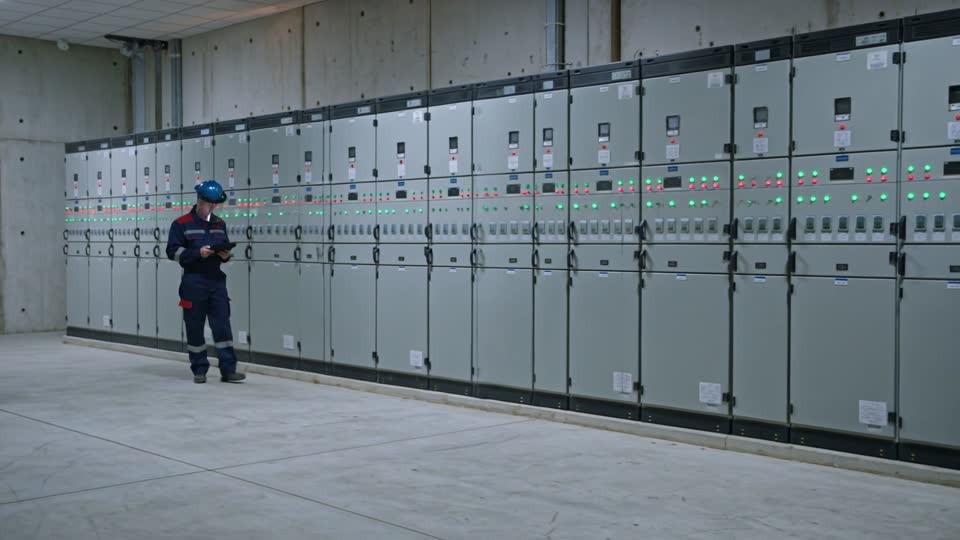
An electrical maintenance program is a list of equipment, a list of tasks and a plan for switching the building off. Most of the value, and most of the cost, sits in the shutdown.
CCT 01What an electrical maintenance program actually covers
“Annual electrical maintenance” can mean a walk-through with a thermal camera or a weekend shutdown with breaker testing, cleaning and a report on every switchboard. Before comparing prices, define the program in four parts.
- The asset register. Every piece of distribution equipment in scope: the main switchboard, distribution panels, transformers, motor control centres, transfer switches, busway and large disconnects, with location, rating, age and the loads each one feeds.
- Criticality. What happens if each item fails. A main switchboard serving an occupied tower, the panel behind a freezer line and a lightly loaded tenant panel do not deserve the same attention or frequency.
- Tasks by item. Visual inspection, cleaning, connection checks, operating and testing breakers and protective relays, insulation testing, infrared scanning under load, and transfer-switch exercise. Which tasks apply depends on the equipment, the manufacturer’s instructions and its condition.
- Records and follow-up. A report per item, a deficiency list ranked by risk, and a clear split between routine maintenance and capital replacement.
Without a register, each year’s contractor rediscovers the building and nobody can show what was tested or deferred. Build it once, keep it with the single-line diagram, and make every report reference it. The switchgear and transformers page covers the equipment that usually sits at the top of the register.
CCT 02CSA Z463: which edition, and when it binds you
CSA Z463, Maintenance of electrical systems, is the Canadian reference for building an electrical maintenance program. Its history matters, because older material describes it in a way that is no longer accurate.
Z463 was first published in 2013 as a guideline, and CSA’s white paper from that period calls it voluntary, not mandatory.1 The current edition is Z463:24, the third. It supersedes the 2018 edition and the 2013 guideline, is written as a standard, and converts many earlier advisory criteria into mandatory requirements; it also excludes maintenance of utility-owned supply equipment.2
“Mandatory” inside a standard means mandatory for anyone who has agreed to follow it. This page found no Alberta regulation that adopts Z463 by reference, so in practice it becomes an obligation when a contract, an insurer, a lender or the owner’s own safety program names it. That is the useful point for a buyer:
- name the edition in the maintenance contract (for example, “CSA Z463:24”), not just “Z463”;
- ask each bidder to say which clauses their scope meets and which it does not;
- treat Z463 as the framework for the program and the manufacturer’s instructions as the source for equipment-specific tasks.
Z463 sits beside CSA Z462, the workplace electrical safety standard, now in its 2024 edition.3 Z462 governs how workers stay safe around energized equipment; Z463 governs what gets maintained and how often. The arc flash requirements guide explains how Z462 and Alberta’s OHS Code fit together.
CCT 03Who does what in a maintenance program
| Item | Owner or decision-maker | Done by | Get in writing |
|---|---|---|---|
| Program scope and budget | Owner or asset manager | Owner, with the maintenance contractor or engineer | Equipment list, tasks, standard and edition |
| Asset register and single-line diagram | Owner | Contractor or engineer builds it; owner keeps it | Format and who updates it after each visit |
| Annual electrical permit | City of Calgary | The facility or its maintenance contractor applies | Permit holder and what it covers at this site |
| Infrared scan under load | Owner authorizes | Thermographer or electrical contractor | Equipment scanned, load at the time, findings ranked |
| Shutdown date and tenant notices | Owner or property manager | Property manager coordinates; contractor supplies the method | Notice periods, affected loads, restart list |
| Utility disconnect and reconnect | ENMAX Power | Requested by the contractor | Booking, off-hours charges, fallback date |
| Breaker, relay and insulation testing | Owner authorizes | Qualified testing personnel | Test methods, acceptance criteria, results per item |
| Fire alarm, emergency lighting, generator testing | Owner (including a lessee in care and control) | Fire alarm technician, electrician, generator technician | Which vendor covers which test and report |
| Deficiency repairs | Owner approves | Electrical contractor | Priced separately from routine work |
| Capital replacement recommendations | Owner | Contractor or engineer advises | Evidence for each recommendation |
The row most often left unassigned is the restart: someone must confirm the fire alarm panel is normal, elevators have returned to service, building automation has recovered and refrigeration has restarted. Name that person before the date is set.
CCT 04The City of Calgary annual facility permit
Calgary requires an annual electrical permit where a facility employs a full-time journeyman electrician, and an electrical contractor doing maintenance at a facility may also apply for one.4 The 2026 fee is $156 plus a $6.24 Safety Codes Council fee, $162.24 in total.5 For an owner, the practical question is who holds the permit: the facility itself, or the maintenance contractor. Ask the City which work the permit covers at your site, and whether a larger alteration planned during a shutdown needs its own permit.
The City’s inspection data shows how the annual permit is used. The City issued 232 annual facility electrical permits in 2025.6 Of the 186 whose address matches a non-residential parcel on the assessment roll, 121 were at institutional and special-purpose properties such as schools, hospitals, utilities and transit facilities.6 Commercial and industrial properties hold far fewer, which fits the rule: large institutions are the ones most likely to keep electricians on staff.
Two timing points matter when reading these counts:
- Batch issuance. About half of each year’s annual permits are issued in one batch between April and July; in 2025, 117 of the 232 were issued in June.6 The 2026 figure to date is only 14 because the batch has not yet appeared in the data. It is not a decline.
- An unexplained step. The annual count roughly halved after 2022, when an earlier spring batch stopped appearing. The City does not document why, so the change should not be read as less maintenance work.
The commercial permits guide covers trade permits, plans review and inspections. Contains information licensed under the Open Government Licence – City of Calgary.
CCT 05Infrared scanning: find the problems before the shutdown
An infrared scan is done with the equipment energized and carrying load, so it finds what a de-energized inspection cannot: a loose or corroded connection, an overloaded conductor, or an unbalanced phase showing as heat. Scan first, and the shutdown can target the connections that showed heat.
A scan report is only as useful as its context. Ask for:
- the equipment scanned, matched to the asset register;
- the load on each item when it was scanned, since a lightly loaded panel hides problems;
- each finding ranked by severity, with a photograph and a thermal image;
- a recommended action and a time frame for each finding;
- items that could not be scanned (covers that could not be opened safely, equipment without viewing windows) and why.
Opening covers on energized switchgear to scan it is itself energized work, which is why the scan needs a qualified crew and, in larger equipment, arc flash labels and a current arc flash study. Some owners add infrared viewing windows during a shutdown so later scans can be done without removing covers. The infrared thermography page covers scan timing and reports, and the arc flash and thermography cost guide covers pricing.

CCT 06Planning the maintenance shutdown
Cleaning, torque checks, breaker operation and most testing need the equipment de-energized. For a main switchboard that means the building off, often with the utility disconnecting the supply. The shutdown is the expensive part of the program, and planning it well is what keeps the price down.
- Choose the window. Weekend and overnight shutdowns suit occupied buildings but cost more. ENMAX charges $352.00 per hour for work the customer requires outside 7:00 a.m. to 4:00 p.m. on weekdays.7
- Book the utility. ENMAX needs at least 3 business days’ notice to schedule disconnect and reconnect work.8 A customer-requested temporary de-energization is free,7 and re-energization is charged at $166.00 per hour.7
- Decide what must keep running. Life-safety systems, servers, refrigeration and heat. Calgary’s January design temperature is −30 °C,9 so a winter shutdown needs a plan for heating, heat tracing and anything that can freeze, often a rental generator.
- Notify tenants. The lease and landlord rules set the notice period. Give tenants the start time, the expected restart time and a contact.
- Write the task list per item. Every task tied to the asset register, so the crew is not deciding on the night what to do.
- Restart in order. Follow a written restart list and check fire alarm, elevators, building automation and refrigeration before the crew leaves.
De-energized means verified
Alberta’s OHS Code requires hazardous energy to be isolated with a secured energy-isolating device before equipment is serviced, tested or inspected,10 each worker involved to have a personal lock,10 and the equipment to be tested and confirmed safe before work starts.10 A utility disconnect does not remove every source: generators, back-feeds and stored energy remain. Maintenance should be planned around a shutdown, not done live to avoid one. This page is planning information, not a procedure.
CCT 07Where electrical maintenance meets life-safety maintenance
A building’s electrical program overlaps with its fire code obligations, and the two are often bought from different vendors. The owner carries the fire code duties, and “owner” includes a lessee or anyone in care and control of the building.11
- Fire alarms are inspected and tested to CAN/ULC-S536,11 and each annual inspection must fall within 12 months of the previous one.11
- Self-contained emergency lighting units are tested monthly; other emergency lights and exit signs are inspected annually.11
- Emergency generators follow CSA C282. Calgary’s guidance cites the 2015 edition,11 while CSA’s current edition is C282:24,12 so refer to the edition the fire code references rather than “the latest”.
- Deficiencies found by service companies are expected to be reported within 10 business days.13
Line these up with the electrical program. A switchboard shutdown is the natural time to test a transfer switch under real conditions, and emergency lighting failures are often circuit problems that the electrical contractor, not the fire alarm technician, fixes. See fire alarm and emergency lighting inspections and generators and transfer switches.
CCT 08Writing and pricing the maintenance contract
Maintenance proposals are hard to compare because each bidder assumes a different scope. Fix the scope and the comparison becomes straightforward. A usable request for pricing states:
- the equipment covered, by asset register reference, and the tasks per item;
- the standard and edition the program follows;
- the number of shutdowns, their expected length and whether they fall after hours;
- who supplies temporary power, and who handles tenant notices and restart checks;
- consumables, test equipment and reporting format;
- how deficiencies are priced: as unit rates, a separate quotation per item, or an allowance.
Separate routine work from repairs and capital recommendations on the invoice as well as in the contract, and ask for evidence (test results, images, measurements) behind every replacement recommendation. Labour is the largest line; the commercial electrician rates guide explains why charge-out rates differ from the wages published for the trade.
The programs look different by building type. Managed portfolios want one report format across buildings, plants schedule around production outages, and condo boards need a shutdown plan residents will accept and a reserve fund that anticipates the capital items the program finds.
Questions people ask
What is electrical preventive maintenance?
It is planned work on a building’s electrical distribution equipment, done before failure rather than after it: inspection, cleaning, connection checks, breaker and relay testing, insulation testing and infrared scanning, with a report for each item. The program is defined by an asset register, a task list per item and a plan for the shutdowns the work needs. CSA Z463 is the Canadian framework for such programs; its current edition is Z463:24.2
How often should switchgear be maintained?
No single interval fits every building. Frequency should follow the equipment’s criticality, condition, environment and the manufacturer’s instructions, and a program built on CSA Z463 sets it that way rather than by habit. A main switchboard in a dusty plant needs more attention than a panel in a clean office. Infrared scanning between shutdowns is a common way to decide whether a shutdown can wait.
Do I need an annual electrical permit in Calgary?
Calgary requires one if your facility employs a full-time journeyman electrician, and a contractor doing maintenance at a facility may also apply.4 The 2026 fee is $162.24 including the Safety Codes Council fee.5 Confirm with the City what the permit covers at your site before relying on it for a larger alteration.
What is shutdown maintenance?
It is the maintenance that can only be done with equipment de-energized, grouped into a planned outage: cleaning and inspecting switchgear, checking connections, operating and testing breakers, and testing transfer switches. It needs a utility booking where the supply is disconnected, tenant notices, temporary power for critical loads and a written restart list. ENMAX needs at least 3 business days’ notice for disconnect and reconnect work.8
What belongs on a building electrical preventive maintenance checklist?
At minimum: the asset register and single-line diagram; the tasks and test methods for each item; the latest infrared scan and its open findings; the shutdown plan, tenant notices and restart list; the annual permit holder; the fire alarm, emergency lighting and generator test schedule and vendor for each; the deficiency list with owners and dates; and the capital items recommended, with evidence.
Is CSA Z463 mandatory in Alberta?
CSA’s 2013 material described Z463 as a voluntary guideline.1 The 2024 edition is written as a standard with mandatory requirements, but those bind the parties that adopt it. This page found no Alberta regulation that adopts Z463 by reference, so it becomes an obligation when a contract, insurer or company safety program names it. Name the edition in your contract.
Sources
- Z463 - Maintenance of Electrical Systems (white paper)CSA Group · White paper dated July 2013; retrieved 2026-09-25
- CSA Z463:24, Maintenance of electrical systems (product page and preface)CSA Group · retrieved 2026-09-27
- CSA Z462:24 Workplace Electrical Safety - Online TrainingCSA Group · retrieved 2026-09-25
- Electrical permits for contractorsThe City of Calgary · retrieved 2026-09-25
- 2026 Building & Trade Permit Fee Schedule (R2026-02)The City of Calgary · 2026 fee schedule, revision R2026-02; retrieved 2026-09-25
- Electrical Permits and Inspections (dataset vxgy-id5s)The City of Calgary, Open Government Licence – City of Calgary · queried 2026-09-25
- ENMAX Power Corporation Distribution Tariff, Terms and Conditions Fee ScheduleENMAX Power Corporation · Effective January 1, 2026
- Temporary disconnect / reconnectENMAX Power Corporation · retrieved 2026-09-25
- National Building Code - 2023 Alberta Edition, Volume 1, Division B, Appendix C, Table C-2 Climatic Design Data for Selected Locations in AlbertaAlberta Municipal Affairs / National Research Council of Canada · 2023 Alberta Edition, second printing incl. revisions and errata released April 2026
- Occupational Health and Safety Code, Alta Reg 191/2021 (office consolidation)Alberta King's Printer · Consolidation current as of March 31, 2025 (amendments to AR 210/2024); retrieved 2026-09-25
- Fire Safety Maintenance Requirements (Calgary Fire Department Inspections)The City of Calgary (Calgary Fire Department) · Latest revision May 1, 2024 (NFC(AE) 2023); retrieved 2026-09-25
- CSA C282:24 Emergency electrical power supply for buildings (store listing)CSA Group · retrieved 2026-09-25
- Fire Marshal Bulletin March 5, 2025-001: Fire Alarm ReportingThe City of Calgary (Calgary Fire Department, Fire Marshal's Office) · Issued March 5, 2025; retrieved 2026-09-25
Related
-
 E-101
Tenant improvements
Office, retail and restaurant fit-outs: what the base building provides, what the tenant’s electrical scope covers, the drawings and the permits.
-
 E-102
Commercial service upgrades
Raising a building’s service: capacity checks, the ENMAX application and investment, CT metering, drawings and the shutdown.
-
 E-103
Three-phase power
New three-phase services and single-to-three-phase conversions for equipment, kitchens, shops and EV charging.